What is a Forward Deployed Engineer?
An FDE is an engineer "embedded" directly inside a customer's environment to deploy, customize, and operate a complex piece of software together with them until it actually works in the real world — rather than sitting in the "back office" waiting for support tickets to come in.
An FDE is typically involved across the entire project lifecycle: from requirements analysis and design, through system integration, all the way to go-live and post-launch optimization. The biggest difference from a regular Software Engineer is that an FDE doesn't just code against a pre-written spec — they have to understand the business themselves, spot problems themselves, and be able to write code to fix things on the spot.
You can think of an FDE as the intersection of three things: engineering ability, product thinking, and customer-facing consulting skills.
Why did this role come about?
The term FDE is believed to have started gaining traction at Palantir roughly two decades ago, when the company sent engineers to work directly inside government agencies, military units, and other places with high-security systems, fragmented data, and operational quirks that no ordinary consulting team could handle.
The deeper reason lies in a simple fact: enterprise and AI products keep getting more complex, while a customer's actual infrastructure, data, and processes are always messier than what the product team imagined when building the feature. Customer Success or Implementation Consultant teams only operate within existing configuration options, while internal product engineers usually aren't close enough to the customer to understand their context. The FDE exists to fill exactly that gap.
Starting from Palantir, the model spread to a string of other companies — Stripe, Datadog, Salesforce, Intercom — and more recently to a wave of AI companies like OpenAI and Anthropic, who need a strong enough technical team to actually put AI into production inside customer businesses, rather than stopping at a demo or a proof of concept.
How is FDE different from DevOps, Solution Architect, or a pure Software Engineer?
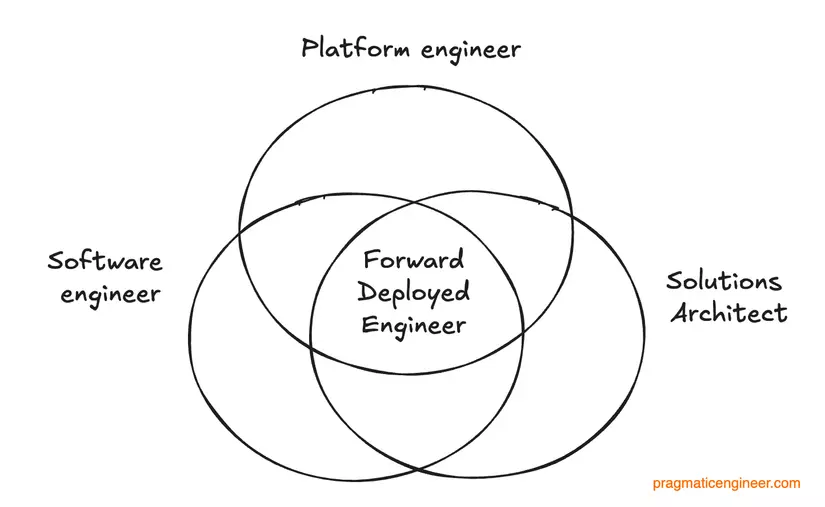
An easy way to picture it:
- Solution Architect usually handles the pre-sales side: advising on the solution, running demos, building a POC to close the deal. Once the contract is signed, they're often not the ones who directly build and operate that solution.
- DevOps/Infrastructure Engineer is strong on pipelines, cloud infrastructure, and system reliability, but typically works "inward-facing," serving their own company's product or systems.
- Software Engineer focuses on building product features according to an internal roadmap.
- FDE takes all of the above technical foundations but points them straight at the customer: understanding the architecture, getting hands-on with infrastructure, and writing code themselves to turn the promises made during the sales pitch into something that actually runs inside the customer's environment.
How do you become an FDE if you're currently a DevOps, Solution Architect, or Software Engineer?
What's interesting is that there's currently no standard path to becoming an FDE — most people in this role got there through hands-on experience rather than a degree or certification. The most common backgrounds are Software Engineer, DevOps/Infrastructure Engineer, Data Engineer, and Machine Learning Engineer.
A few experiences worth actively building up if you want to move into FDE: having directly deployed systems to production and handled real incidents, having integrated APIs with enterprise platforms like CRM/ERP/data warehouses, having debugged gnarly infrastructure issues, and — just as important — having worked directly with customers or a partner's technical team.
If you're coming from a specific role:
- DevOps Engineer: you already have the foundation in CI/CD, cloud, and system reliability. What you need to add is proactively asking to join direct deployment/integration projects for large customers, plus sharpening your ability to explain technical issues to non-technical people.
- Solution Architect: you're already strong at understanding customer problems and designing solutions. What you need to practice is being able to write, patch, and fix code yourself instead of just drawing up the architecture and handing it off to another team to build.
- Software Engineer: proactively ask to rotate onto enterprise implementation projects, get comfortable with the ambiguity of real-world requirements instead of only receiving fully specified tickets, and build up direct customer communication skills.
Overall, the key is the same: throw yourself into real deployment projects, build systems thinking, and practice solving problems in an imperfect, information-scarce environment.
Are there companies in Vietnam hiring for FDE yet?
Yes, and quite a few have shown up in the past few months. A few examples I found:
- HBLAB JSC (Hanoi) posted an "AI Automation/Forward Deployed Engineer" opening with a fairly clear description: working directly with customers to understand pain points, building automated solutions with low-code platforms like n8n, Dify, and Make in short 3-7 day sprints, writing and tuning prompts for LLMs, and integrating via the Google Workspace and Slack APIs/SDKs. Requirements include proficiency in Python or JavaScript, understanding how LLMs work (OpenAI, Gemini, Anthropic APIs), 1-2 years of experience with low-code tools, and a basic understanding of REST APIs/Webhooks/OAuth.
- Rockship (Ho Chi Minh City), a software consulting firm, is hiring a "Forward Deploy Engineer" with high technical requirements, working directly with international customers.
- FPT Software (Hanoi) has posted a "Forward Deployed Engineer – Data Analytics/Science" listing.
- Transform Group (Ho Chi Minh City) is even hiring an FDE/Key User intern.
- Michael Page Vietnam (a headhunter) has an "AI Engineer (FDE) | Customer-Facing AI Builder" listing for one of their clients.
- HD Global Career has posted a "Senior Forward Deployed Engineer (LLM, Agent Architect)" listing.
A few personal thoughts
First, FDE is a clear sign of the trend toward valuing generalist engineers in the current era. Instead of clean separation between sales, presales, engineering, and CS like before, companies now want one person who understands the tech, understands the business, and communicates well with customers — all to shrink the time between signing the contract and the customer actually seeing value from the product. In other words, FDE is a way to cut out the middle layers (sales → SA → PM → dev → support) that tend to distort information and slow down feedback. A good FDE can listen to a customer describe a problem and code the fix right there, without routing through several layers of handoff.
Second, just like DevOps years ago, the definition of FDE varies wildly from company to company — it's far from consistent. You can see it clearly just from the Vietnam job listings above: FDE at HBLAB leans toward automation and AI agents, FDE at Rockship leans toward technical consulting for overseas customers, and FDE at FPT Software is tied to data analytics. It's the exact same story as DevOps more than a decade ago — every company defines the role according to its own needs. So if you're considering applying for an FDE role, my advice is to read each company's specific job description carefully instead of just going by the title.
Closing thoughts
FDE isn't really a brand-new profession — it's more like an official name finally being given to work that many skilled engineers have quietly been doing all along: getting in the trenches with customers to turn a product into real value. With the current AI wave, demand for this is expected to grow strongly.
If you're currently a DevOps engineer, Solution Architect, or Software Engineer and you find you enjoy directly solving problems for customers rather than only working behind a screen, FDE might be a direction worth considering.
I'd love to hear your perspective on this, especially from anyone currently working as an FDE or considering a move into the role!